


Real-Life Vampire Lore: Myths and Truths That Will Make Your Skin Crawl

From Nation, For Nation - Pulse of the Nation

5 Things You Didn't Know About Jimmy Carter
Animal Vision: Seeing the World Through Their Eyes
We all know that dogs can’t see every color under the sun and that cats are basically the ninjas of the night, but what about the other creatures out there? How does a mantis shrimp or a hammerhead shark view the world?
Get ready, because we’re about to explore the wild, weird, and totally mind-blowing ways animals experience their surroundings. Spoiler alert: It’s nothing like what you’re used to!
Eyes Wide Wild: How Animals See the Unseen
Animal vision is way more exciting-and bizarre-than we could ever imagine. While humans are stuck peering at the world in a small slice of the light spectrum (hello, reds, greens, and blues), many animals have superpowers in the vision department. Some can see wavelengths of light that are totally invisible to us, like ultraviolet (UV) or even infrared (IR) light. It’s like they’re seeing a whole other dimension that we can’t even begin to comprehend!
Take bees, for example. While we humans might enjoy the sight of a beautiful flower, a bee is out there seeing a completely different version of that same flower-one lit up with ultraviolet markings that we’ll never notice. These UV patterns act like secret road signs for bees, guiding them straight to the nectar they love so much. So while we’re squinting at a rainbow, trying to catch all the colors of the spectrum, honey bees are zipping around, catching hues we can’t even detect.
Whether it’s a bee detecting hidden patterns, a snake hunting in the dark, or a bird seeing ultraviolet signals, animals have evolved to perceive the world in ways we can only dream of. So next time you think you have a sharp eye, just remember: there’s a whole lot happening out there that you can’t even imagine!
1. Mantis Shrimp
If you thought your vision was sharp, you’re in for a surprise! Enter the mantis shrimp, an ocean dweller whose eyes are unlike anything you’ve ever seen. Mantis shrimp have 16 types of photoreceptors compared to our measly three, meaning they can detect a stunning array of colors that we can’t even imagine. But here’s the kicker: despite having all those photoreceptors, researchers believe mantis shrimp don’t necessarily see more colors than us-they just process them differently.
Oh, and their eyes move independently, meaning they can scan their surroundings in multiple directions at the same time. Imagine being able to check behind you and in front of you without turning your head-pretty handy when you're a tiny predator in a big ocean!
2. Birds
Many birds, especially those with vibrant plumage, see the world in a whole different light-literally. Like bees, they can detect ultraviolet (UV) light, revealing markings on flowers, feathers, and even food sources that are completely invisible to us.
UV vision isn’t just for show, either. It plays a crucial role in mate selection since many bird species have UV-reflective feathers that signal their health and genetic fitness. Some birds, like kestrels, even use UV light to track prey-vole urine reflects UV, essentially leaving a glowing neon trail right to dinner.
3. Dragonflies
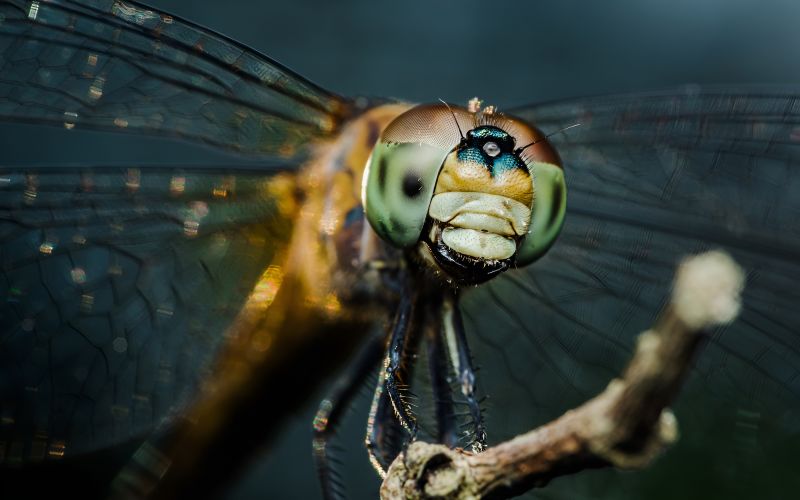
Dragonflies have some of the most advanced eyes in the insect world. Their compound eyes contain up to 30,000 individual lenses, giving them an almost 360-degree view of their surroundings. Unlike humans, who focus on objects using a single lens, dragonflies use thousands at once, allowing them to detect movement with lightning-fast precision.
They also have up to 11 types of photoreceptors, making them capable of detecting ultraviolet light, polarized light, and even subtle shifts in color that help them track prey. This razor-sharp eyesight, combined with their rapid wing beats, makes them some of the most precise hunters in the air, snatching prey mid-flight with unmatched accuracy.
4. Garden Snails
Garden snails may not have the most advanced vision, but their eyes are perfectly suited for their slow-paced lifestyle. Their two upper tentacles house their eyes, which allow them to detect light and dark rather than sharp details. While their vision is blurry, they compensate with an extraordinary sense of touch and chemical detection that helps them navigate their environment.
Interestingly, snails can regenerate their eyes if damaged-a handy trick when you’re a soft-bodied creature facing the dangers of the natural world.
5. Geckos
Geckos are night vision champions. Unlike humans, who struggle to see in low light, geckos have super-sensitive eyes that allow them to see color even in near-total darkness. In fact, their vision is 350 times more sensitive to light than ours. This is due to the high concentration of rod cells in their eyes, which detect even the faintest glimmers of movement.
Geckos also see ultraviolet light, which helps them locate prey, identify mates, and navigate their environment. Their eyes are larger relative to their head size than most other reptiles, giving them a wide field of view and exceptional depth perception.
6. Hammerhead Sharks
Hammerhead sharks are the masters of panoramic vision. With eyes positioned on the sides of their hammer-shaped heads, they have an almost 360-degree field of view. This gives them exceptional depth perception, a key advantage when hunting fast-moving prey like fish or squid.
Their electroreceptive abilities also come into play-they can detect the faint electrical signals emitted by prey hiding under the sand. Combined with their unique eye placement, this makes hammerheads some of the ocean’s most efficient hunters, able to scan vast areas of the sea floor in search of a meal.
So next time you see a hammerhead shark gliding through the water or a bird flying above, just think about how their vision allows them to experience the world in a very unique way. It’s like living in a parallel reality, one where colors, shapes, and movements are all seen in an entirely different light. →
From Globe, For Globe - Pulse of the Planet

It all sounds like something from a history book, but there are qualities here that would impress the most forward-thinking of modern architects.
China is one of the fastest growing and technologically evolving nations in the world - with high-tech building industries flexing their ample construction muscles for the past decade in places like Beijing and Shanghai, it’s pretty unbelievable that tens of millions still live in underground homes just a few hundred miles away.
21st Century Cave-People
It may sound funny or insulting calling someone a caveman/cavewoman in the 21st century but when you consider that most of these underground, burrowed dwellings have all the facilities of modern homes, perhaps in China it shouldn’t be taken as an insult.
These cave houses don’t need much for building materials and since the hills and mountains they are dug into act as natural insulation all year round, they are actually more energy efficient than most conventional family homes!
The caves, called yaodong in Chinese, are usually dug into the side of a mountain. Their semicircular entrances are covered with rice paper or woven blankets to serve as makeshift doors. They’re not much to brag about, but the swankier caves are equipped with modern-day amenities like electricity, phone and plumbing if there’s enough money to spend. Otherwise, with no running water or sewage system, locals are as reliant as ever on the raging muddy waters of the nearby river.
Intrinsically Linked to the Earth
The majority of China’s cave dwellers can do without all these expensive features, though, and prefer to enjoy their homes’ natural bonuses - high ceilings and lots of space with a nice yard out front where you can exercise and sit in the sun.
The village’s nine terraced levels are linked by stone stairways that date back to the Ming Dynasty, Most homes still have paper windows rather than glass panes. Inside, their owners sleep on large stone beds, known as kang; cool in the summer, but with cavities underneath so that fires can be lit inside them during the winter months. Pretty cool!
It all sounds like something from a history book, but there are qualities here that would impress the most forward-thinking of modern architects. Intrinsically linked to the earth, cave homes are, unsurprisingly, pretty kind to the environment.
Sounds good to you? A basic one-bedroom cave without plumbing rents for about $30 a month. A cave with three bedrooms and a bathroom might sell for $46,000, the New York Times reported.
→

Referred by ripleys.com - where the world’s most extraordinary stories are discovered and celebrated.