


How Long Does It Actually Take to Digest Swallowed Gum?

From Nation, For Nation - Pulse of the Nation

That One Time Napoleon Was Attacked By Rabbits
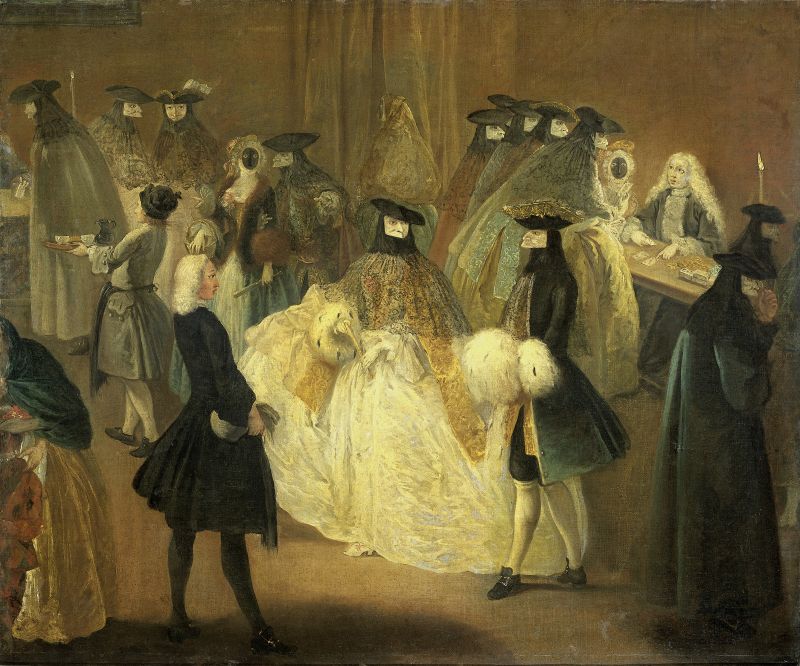
Unmasking The Dark History Of The Moretta
If you’ve been invited to a masquerade ball this year and want to wear something that screams “creepy-casual,” consider adding a moretta to your ensemble.
Old School Sunscreen
When we think of carnival masks of Venice, Rio, or New Orleans, we think of bright colors and ornate designs. But, if you go waaaay down to the opposite end of the spectrum, you’ll find the moretta, a woman’s mask of plain black with no sparkle or flare, and no opening for the nose or mouth. In artists’ depictions, they look decidedly eerie; it almost appears as though someone has cut out the person’s face.
Of all the styles of masks worn at the time, the moretta was as sleek and simple as could be. Likely made of a material like cardstock or cardboard. It would have been waxed, painted over, or had black fabric affixed to it for a blank effect.
Popular in Paris and Venice during the mid-to-late 17th century, the moretta was an oval-shaped, black mask of French origin. It disguised the lady who wore it. It also stayed put with a button held between the teeth, rendering the wearer mute. It’s no wonder the moretta, meaning “dark,” was also sometimes called the “servetta muta,” or “mute servant.”
From the late 1600s until about 1700, women in Paris had a tradition of covering their faces in public. “Women didn’t always wear hats, so they used masks, including the moretta partially to keep their fashionably pale skin safe from the sun,” says James H. Johnson, Professor of History at Boston University and author of Venice Incognito: Masks in the Seren Republic.
The plain, dark mask accentuated the paleness it helped protect. A moretta might be also worn on a visit to a convent for the sake of modesty. And, of course, the quiet created by that button.
Hiding In Plain Sight
Masks in Paris at the time were also worn as a “protection against charges of being immodest,” Johnson says. It was rare for an upper-class woman to go walking in public alone but, he points out, not rare for prostitutes. A lady could walk out in public in a mask and not be seen as being that kind of girl.
You would think that women at this time would see the near-literal buttoning of their lip and “invisibility” in public as an inconvenience. However, for most, being covered up and unheard almost gave them a bit more freedom.
Masks could be “about protecting a psychic space when you don’t have physical space,” Johnson says, and that it was somewhat akin to the modern habit of “wearing sunglasses, not to disguise ourselves but to create a kind of psychic distance so that we don’t have to acknowledge people if we don’t want to.”
Meanwhile, Venice in the 1660s and 1670s was seeing the dawn of new social spaces. From enclosed theaters, and public cafes to gambling halls. Venice had a rigid social hierarchy. “The two or three percent of the population who are noble did not associate closely with or talk to commoners.” Now, suddenly, there were public spaces in which the mingling of classes could occur.
In a sartorial move, likely unique to Venice, “people began to wear masks in public as a way of facilitating being very close to a different social status,” in these new class-fluid spaces, Johnson says. Aristocrats could drink and gamble alongside absolute nobodies and no one would ever know.
Who Was That Masked Woman?
Venetian painter Pietro Longhi often showed masked figures in his work, including women in morettas, as in The Rhinoceros and The Meeting of the Procuratore and His Wife, which, as the University of Mary Washington blog observes, shows a lady removing her moretta for reasons unknown. As with the mysterious moretta, there’s some fun to be had in this little bit of mystery.
→
From Globe, For Globe - Pulse of the Planet
Can an object truly be cursed?
For centuries, people have been captivated by stories of ordinary items that bring extraordinary misfortune. From haunted paintings to ancient relics, some objects seem to carry a dark history that haunts anyone who dares to own them.
Let’s take a spine-tingling journey into the world of real-life haunted objects-just make sure you leave the lights on!
The Anguished Man: When a Painting Screams Back
Meet The Anguished Man, an unsettling painting of a man’s tortured face that not only looks terrifying but also comes with its own paranormal baggage. Legend has it that the artist took his own life shortly after completing the painting, as if the darkness within it had consumed him entirely.
The real horror story, however, began when owner Sean Robinson claimed he started hearing strange noises after bringing the painting into his home-moans, screams, and even faint footsteps echoed through the house at night.
Visitors to Robinson’s home have also reported seeing shadowy figures lurking near the painting or feeling an overwhelming sense of dread in its presence. Could it be that this chilling portrait contains more than just oil and canvas?
The Crying Boy: The Portrait That Survived the Flames
The infamous Crying Boy painting gained notoriety across the UK in the 1980s. Originally created by Italian painter Giovanni Bragolin, the painting became so famous that prints and reproductions have been sold around the world for decades.
But this seemingly innocent portrait of a child crying has become linked to a series of mysterious house fires. It seemed that while everything around it burned, the painting was often found eerily untouched by the flames.
Firefighters were baffled as they continued to find this portrait in unrelated homes that had gone up in smoke. Was it just a bizarre coincidence, or did the painting carry some sort of curse? Reports of the Crying Boy surviving fires became so widespread that people started blaming it for bringing disaster. Many owners destroyed the paintings, while others returned them out of fear.
Ballista Balls: Ancient Artifacts, Modern Misery
Imagine stealing an artifact from an ancient Roman archaeological site, only to have your life turned upside down. That’s exactly what happened with the Ballista Balls-massive stone projectiles used in ancient Roman warfare. After being taken from an excavation site near the Israel and Syria border, the thief experienced years of misfortune that included financial ruin and family breakdowns.
Realizing the balls might be cursed, the thief anonymously returned them to a museum in Israel along with a note apologizing for the theft and saying, “I stole them in July 1995, and since then they have brought me nothing but trouble.” Since then, the Ballista Balls have become infamous for their cursed reputation. It's a stark reminder that sometimes it's best to leave history where you found it.
The Pompeii Curse: Souvenirs That Haunt You for Life
Pompeii, the ancient Roman city frozen in time after the eruption of Mount Vesuvius, is more than just a tourist attraction-it’s home to some allegedly cursed artifacts. Every year, tourists who take a small piece of Pompeii as a souvenir find themselves returning it, often accompanied by letters detailing the misfortune that followed them after their theft.
From illness and accidents to financial disasters, the so-called “Pompeii Curse” has prompted hundreds of artifacts to be sent back to Italy, often with desperate pleas for forgiveness. While scientists attribute these stories to guilt-induced coincidences, the curse continues to haunt those brave (or foolish) enough to pocket a piece of the past.
The Mummified Monk: A Haunting 900-Year-Old Secret
One of the strangest discoveries in recent history is the self-mummified monk found hidden inside a 900-year-old Buddha statue. In 2014, researchers scanning the statue discovered the preserved body of a Buddhist monk who had undergone the grueling process of self-mummification. This ancient practice involved years of intense meditation and a strict diet designed to prevent the body from decaying.
But the story doesn’t end there-when the monk’s body was examined further, researchers found ancient scrolls with mysterious messages hidden inside. The eerie preservation of his body and the secrets buried within continue to baffle scholars and spark curiosity about the lengths people will go to achieve spiritual immortality.
So, Are These Objects Truly Cursed?
While many skeptics point to psychological explanations or simple bad luck, there’s no denying the chilling tales that surround these artifacts.
Whether you believe in the supernatural or not, one thing is certain—next time you come across an ancient relic or a creepy painting, you might want to think twice before taking it home. After all, some things are better left undisturbed.
Sensing You Want More?
At Ripley Believe It or Not! St. Augustine, an artifact once prized by Haiti’s President, Papa Doc Duvalier, holds stories that both intrigue and frighten.
From daily mysterious moisture on the display case to misadventures when he was absent, Voodoo Baby’s presence is impossible to ignore. Dare to pay him a visit? Just one piece of advice: whatever you do, don’t look him directly in the eye!
→

Referred by ripleys.com - where the world’s most extraordinary stories are discovered and celebrated.