


The Tragic Collapse of the Sunshine Skyway Bridge
From Nation, For Nation - Pulse of the Nation
That One Time Napoleon Was Attacked By Rabbits
The Students Who Stole the Stone of Destiny
It’s almost Christmas 1950, and while most folks are merrily sipping their eggnog at home, four Glasgow students with a burning passion for Scottish nationalism are about to pull off the heist of the century.
To understand how things got to that point, we need to go back a few centuries. Enter the Stone of Destiny (also known as the Stone of Scone), a 336lb slab of pale-pink sandstone that had been used in the coronation of Scottish kings for centuries. Legends about it abound - perhaps the stone is the Biblical Jacob’s Pillow, perhaps it was part of the Roman Antonine Wall.
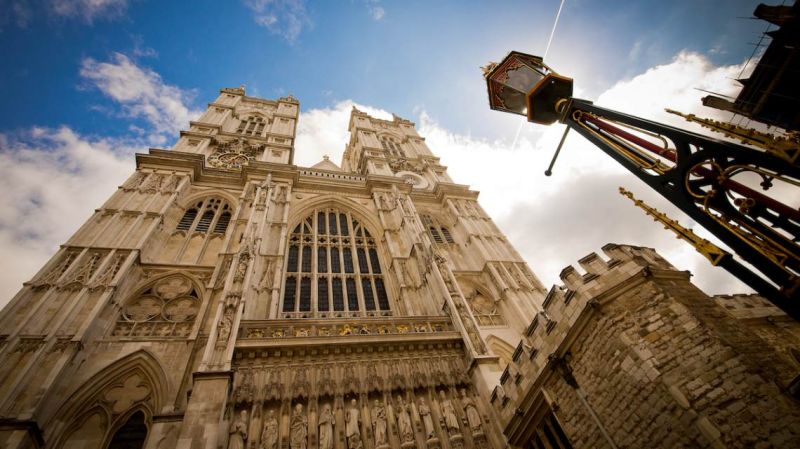
Either way, King Edward I stole it from the Scotts during the Independence Wars in the 13th century and brought it to England’s Westminster Abbey - where this unassuming block of stone was mounted under an oak coronation chair and, you guessed it, used during the coronation of English monarchs from then on.
Enter the Stone Raiders
So let’s go back to December 1950, when a team of four Scottish students (Ian Hamilton, Kay Matheson, Gavin Vernon, and Alan Stuart) set out to “reclaim” the stone and bring it back home.
This wasn’t an easy task and on the first night they tried breaking into Westminster Abbey, Hamilton was caught by a security guard - who let him off with a warning. The group returned on Christmas Day and this time, it all worked out so well, it was almost like an old Hollywood heist movie. After jimmying the Abbey’s door open in the middle of the night, the group managed to remove the stone from under the throne - only to have it break in two.
In a bit of a panic, Hamilton grabbed the smaller 90lbs piece and ran out of the Abbey - only to realize he had lost his car keys inside the Abbey. So back in he went, grabbing not only his keys but also the larger piece of stone they had left behind.
Hide and Stone-Seek
Quickly realizing the whole thing could have serious consequences, the group decided to hide the stone. The larger piece was buried near Kent, while the smaller bit found a temporary home in a Birmingham garage. Soon, police were out in force searching for the stone and looking for “a man and a woman in a Ford Anglia car… with Scottish accents.”
Despite the chaos and uproar, however, the police were not able to find any trace of it, and Hamilton and the gang eventually moved it to Scotland and gave it to the Scottish Covenant Association (an organization campaigning for a Scottish Parliament) for safekeeping.
The Association soon decided the now-repaired stone should be returned since it had already served its purpose (serve as a symbol of Scottish independence) and left it at the ruins of Arbroath Abbey, from where it was then transported back to England and eventually became part of Queen Elizabeth II’s coronation in 1953.
Thieves? More Like National Heroes
The stone was eventually returned to Scotland in 1996 and now resides in its rightful home inside Edinburgh Castle.
Despite all the trouble, the daring thieves were never charged because “no one had been harmed, even if the stone had a bumpy ride.”
Hamilton went on to become a successful criminal lawyer who continued to campaign for self-government in Scotland. He died in 2022 at the age of 97, just months before the coronation of King Charles III in May 2023. For the grand event, the Stone of Destiny traveled back to London, where it was once again placed under the coronation chair to welcome the new king - and then returned to Scottland right after the ceremony.
One can only hope this ride was a lot less bumpy than the previous one. →
From Globe, For Globe - Pulse of the Planet
They speculated that the light somehow transported them back to where they started.
Or Not
In today’s world many misconceptions have been perpetuated-becoming modern day “facts”-when, in reality, myths and hearsay have taken over. Sorry to burst your bubble, but in this weekly column, Ripley’s puts those delusions to the test, turning your world upside down, because you can’t always…Believe It!
Today: Did Roswell start America’s fascination with UFO’s?
America’s First UFO Sighting?
Many Americans believe the first UFO sightings occurred in 1947 at Mount Rainier in Washington and then Roswell, New Mexico. These reports of flying saucers caused a sensation in American newspapers and have led to decades of speculation. But were these really the first UFO sightings in North America? According to the Puritans, the answer’s a firm no.
Strange Happenings in New England
The first recorded UFO sighting occurred in 1639 near present-day Boston and was recorded that same year by John Winthrop, the governor of Massachusetts Bay Colony. His journal entry dated March 1st gives a detailed account of the strange events that set New England abuzz.
Winthrop’s story stands apart from his other, more conventional entries wherein he recorded the real-life successes and challenges facing the Puritans. But on March 1st, his writing described bizarre, otherworldly happenings.
From inexplicable lights to missing hours of time, the X-Files has nothing on this 17th-century tale of unidentified flying objects and even possible alien abduction. But instead of FBI agents, the “Men in Black” in this story wore the costumes of God-fearing Pilgrims.
“As swift as an arrow…”
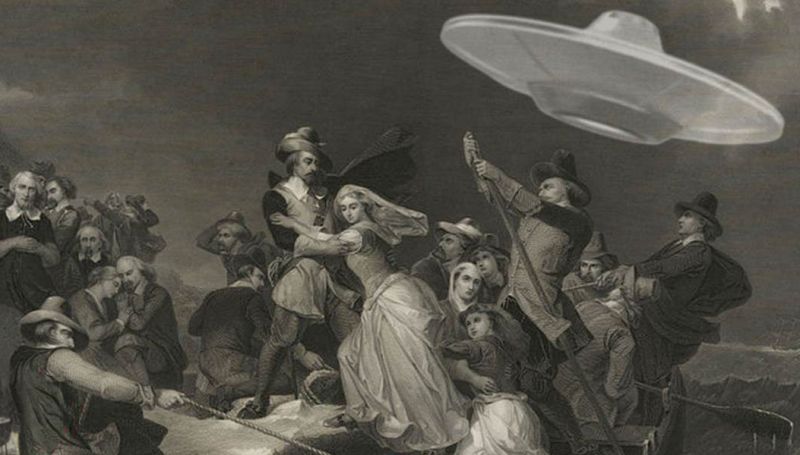
Winthrop relates that James Everell, “a sober, discreet man” was rowing in a boat with two other men in the Muddy River, which emptied through a swamp into a tidal basin of the Charles River. All of a sudden, a great light came into view. According to the men, the light both hovered and then flew at high speed back and forth between their vessel and the village of Charlestown two miles away.
As Winthrop describes it, “When it stood still, it flamed up, and was about three yards square: when it ran, it contracted into the figure of a swine: it ran as swift as an arrow towards Charlton [sic], and so up and down about two or three hours.” Captivated by the sight, Everell and his companions watched the speeding light for hours. Yet, the strangest part of the story still awaited them…
According to Winthrop’s account, as the men watched the light event, “they were come down in their lighter (boat) about a mile” pushed by the tide. Yet, when the light vanished, the men realized their boat had returned to its original location. They had no memory of rowing against the tide or dropping anchor. They speculated that the light somehow transported them back to where they started.
The three men in the boat weren’t the only witnesses to the bizarre UFO event. According to Winthrop, “Divers other credible persons saw the same light, after, about the same place.”
1639: America’s First UFO Sighting
Theories abound about what the Puritans actually observed that night in 1639. The most common theory hypothesizes that the pale light in the sky was an “ignis fatuus.” This phenomenon appears over marshland at nighttime, the result of the combustion of gas from decomposed organic matter. If Winthrop’s account is accurate, though, the light shot back and forth across the sky rather than rose from the marsh below.
We may never know what Everell and his boat companions saw that night. But one thing’s for sure: the 1639 incident marks the oldest recorded UFO sighting in North American history. Some researchers also describe it as the first UFO abduction narrative from the New World.
→

Referred by ripleys.com - where the world’s most extraordinary stories are discovered and celebrated.