



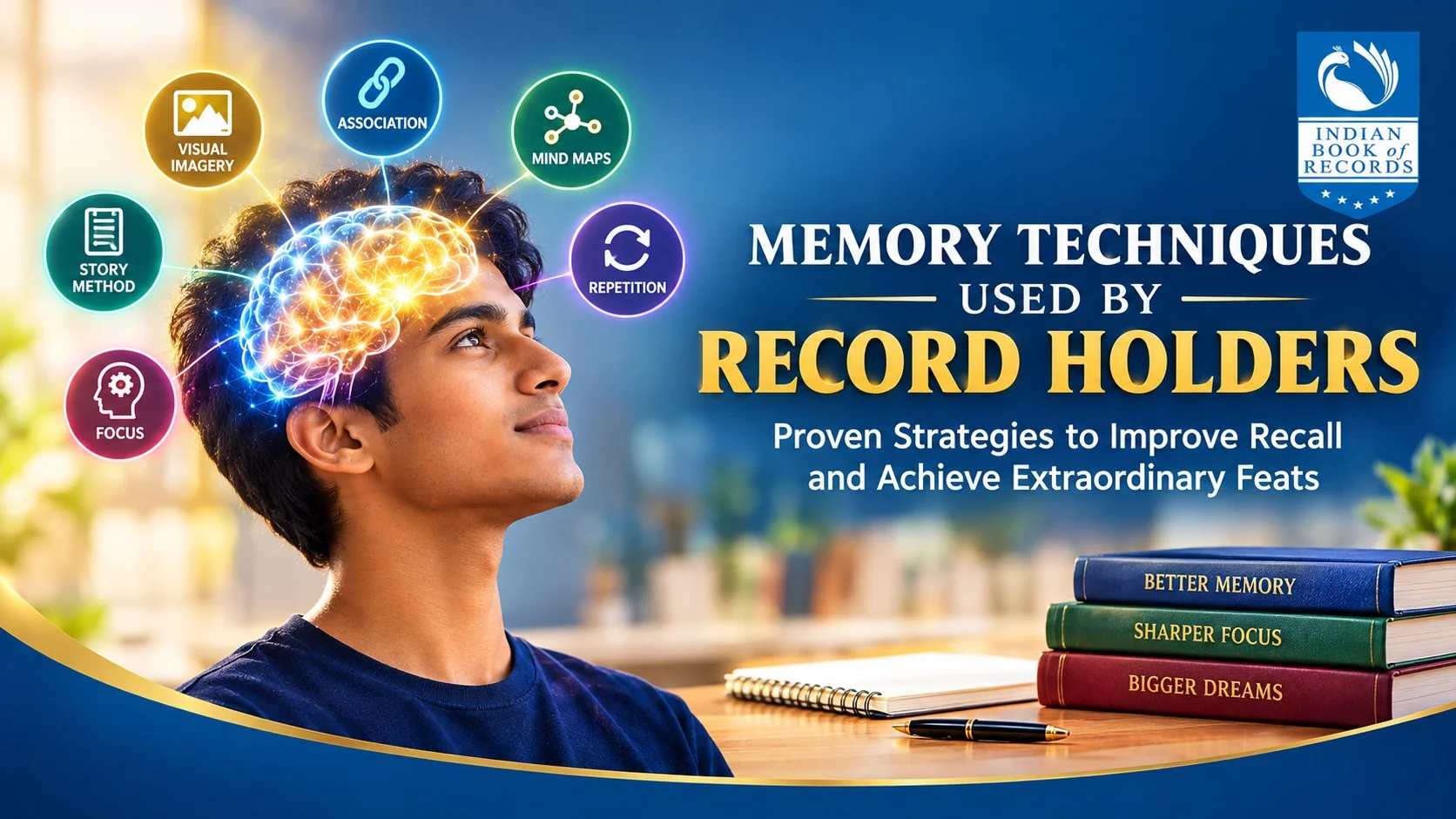
Whether it's reciting thousands of digits, remembering lengthy sequences, solving puzzles at incredible speed, or setting unique records, exceptional memory is often the foundation of remarkable achievements. Many people assume that record holders are born with extraordinary brains, but the truth is quite different. Most successful achievers rely on structured memory techniques that anyone can learn and practice.
Understanding the Memory Techniques Used by Record Holders can help students, professionals, and aspiring record applicants improve their concentration, recall, and confidence. If you're preparing for an academic challenge, a competitive event, or even an Indian Book of Records attempt, mastering these methods can significantly enhance your performance.
Why Memory Plays a Vital Role in Record-Breaking Achievements
Many record attempts require participants to memorize vast amounts of information accurately within a limited time. Strong memory not only improves performance but also reduces mistakes and increases confidence during high-pressure situations.
Whether you're learning hundreds of historical facts, recalling names, memorizing numbers, or performing complex routines, effective memory improvement techniques can give you a competitive advantage.
Unlike natural talent, memory is a skill that improves with consistent practice and the right learning methods.
1. The Memory Palace Technique (Method of Loci)
One of the most famous memory techniques used by record holders is the Memory Palace, also known as the Method of Loci.
This technique involves associating information with familiar locations, such as rooms in your house or landmarks along your daily route. By mentally "walking" through these locations, you can retrieve stored information in the correct sequence.
For example, if you need to remember ten different objects, you imagine placing each one in a different room of your home. Later, you simply visualize walking through your house to recall every item.
Many world memory champions use this strategy because it transforms abstract information into memorable visual experiences.
Benefits
Improves long-term recall
Helps memorize sequences accurately
Ideal for numbers, names, and lists
Enhances visualization skills
2. Mnemonics and Association Method
Another powerful approach among memory techniques for students is the use of mnemonics.
Mnemonics simplify difficult information by connecting it with words, images, rhymes, or stories that are easier to remember.
For example:
VIBGYOR helps remember rainbow colors.
PEMDAS helps remember mathematical operations.
Creating funny stories links unrelated information together.
The stronger and more unusual the association, the easier the information becomes to recall.
This method is widely used by students, competitive exam aspirants, and record holders alike.
3. Chunking Information
The human brain remembers smaller groups of information more efficiently than long continuous sequences.
Chunking divides large amounts of information into meaningful sections.
Instead of memorizing:
483729156428
You remember:
4837 – 2915 – 6428
This simple technique dramatically improves memory capacity and reduces mental overload.
Professional memory competitors frequently combine chunking with visualization for even greater results.
4. Visualization for Stronger Recall
Visualization is one of the most effective memory tricks for learning because the brain naturally remembers images better than plain text.
Rather than reading information repeatedly, create vivid mental pictures.
For instance:
Imagine a giant elephant balancing on a bicycle.
Picture historical events happening inside your classroom.
Visualize scientific concepts as animated scenes.
The more creative and unusual the image, the more memorable it becomes.
Visualization also improves concentration and creativity, making it valuable for both students and record aspirants.
5. Active Recall
Reading notes repeatedly often creates the illusion of learning.
Instead, record holders rely on Active Recall.
This involves testing yourself without looking at the answers.
Examples include:
Answering questions from memory
Explaining concepts aloud
Writing everything you remember before checking notes
Using flashcards
Active Recall forces the brain to retrieve information, strengthening neural connections and improving long-term retention.
6. Spaced Repetition
Another highly effective memory improvement techniques strategy is Spaced Repetition.
Rather than studying everything in one session, information is reviewed at gradually increasing intervals.
A common review schedule is:
Day 1
Day 3
Day 7
Day 14
Day 30
Each review reinforces memory before forgetting occurs.
This technique is especially useful for:
Vocabulary
Historical dates
Mathematical formulas
Speeches
Record attempt material
7. Focus and Concentration Training
Even the best memory methods fail without proper attention.
Successful record holders train their concentration through:
Meditation
Deep breathing
Mindfulness exercises
Distraction-free study sessions
Timed practice routines
Improved focus allows the brain to encode information more effectively, making recall easier during record attempts.
Daily Habits That Improve Memory Naturally
Memory is influenced by lifestyle just as much as study methods.
Healthy habits include:
Regular Exercise
Physical activity improves blood circulation to the brain, enhancing learning and cognitive performance.
Quality Sleep
Sleep strengthens newly formed memories and improves recall accuracy.
Balanced Nutrition
Foods rich in antioxidants, healthy fats, and vitamins support brain health.
Hydration
Even mild dehydration can reduce concentration and memory performance.
Reading Regularly
Reading stimulates multiple areas of the brain and expands knowledge while strengthening recall ability.
How Record Holders Practice Their Memory
Most successful record holders don't rely on last-minute preparation.
Instead, they follow disciplined routines such as:
Daily memory exercises
Timed recall sessions
Repetition with increasing difficulty
Visualization practice
Mock performance sessions
Continuous self-assessment
These consistent habits gradually transform average memory into exceptional recall.
How These Techniques Help During Record Attempts
Many participants applying to the Indian Book of Records perform activities requiring precision, speed, and consistency.
Learning the Memory Techniques Used by Record Holders helps applicants:
Memorize large datasets quickly
Improve concentration under pressure
Reduce errors during performance
Increase confidence
Develop mental endurance
Perform consistently during verification
Whether the record involves academic knowledge, numerical recall, storytelling, language skills, or unique memory-based challenges, systematic training significantly improves success rates.
Tips for Beginners
If you're new to memory training, start small.
Practice for 15–20 minutes daily.
Learn one technique before combining multiple methods.
Use visualization for everyday tasks.
Test yourself frequently.
Review information regularly.
Stay patient and consistent.
Remember, memory improvement is a gradual process rather than an overnight transformation.
Final Thoughts
The Memory Techniques Used by Record Holders are not secret abilities reserved for a select few. They are practical, scientifically supported strategies that anyone can learn with regular practice. Techniques such as the Memory Palace, visualization, mnemonics, chunking, Active Recall, and Spaced Repetition help improve learning efficiency, boost confidence, and enhance overall mental performance.
For individuals aspiring to achieve recognition through the Indian Book of Records, developing strong memory skills can make preparation more effective and improve performance during record attempts. By combining proven memory methods with disciplined practice, healthy habits, and consistent effort, you can unlock your full cognitive potential and take meaningful steps toward accomplishing extraordinary goals.